

Depth with Discipline: Engineering Consistency in Deep-Draw Metal Components
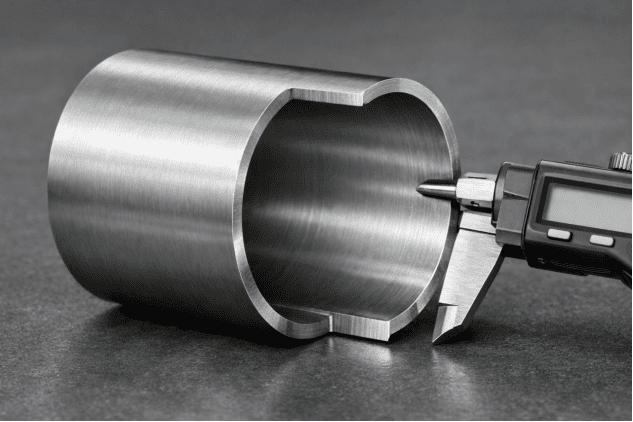
In precision manufacturing, not every component is created through simple cutting or bending. Some shapes demand a far more controlled process – one where material must flow smoothly into form without compromising strength, thickness or dimensional stability. This is where deep drawing becomes essential.
Those of us involved in forming operations understand that deep-drawn components operate under demanding conditions. Whether used in sealing systems, structural housings, or automotive assemblies, their performance depends heavily on how well the material was guided during forming. At Citizen, we approach this process with the discipline expected from a specialist deep-draw component manufacturer, supporting OEMs that cannot afford inconsistency.
Understanding the Deep-Draw Process
Deep drawing is a controlled metal forming technique in which sheet metal is radially drawn into a die cavity to create cylindrical or box-shaped components. Unlike basic stamping, deep drawing requires careful management of material flow and forming pressure.
Key technical considerations include:
- Material flow control, preventing thinning or tearing
- Uniform wall thickness, critical for structural reliability
- Wrinkle prevention, especially in flange areas
- Tooling precision, which governs repeatability
- Lubrication control, reducing friction during forming
When executed correctly, deep drawing produces components with high structural integrity and dimensional consistency. When poorly controlled, it can introduce hidden weaknesses that surface during assembly or field operation.
Where Deep-Draw Components Are Used
Deep-drawn metal components are widely used across automotive and industrial systems where geometry and strength must coexist.
Common applications include:
- Oil seal metal shells and casings
- Cylindrical housings for automotive assemblies
- Structural components in drivetrain systems
- Load-bearing enclosures
- Precision containers used in mechanical assemblies
In many of these applications, the component must withstand vibration, thermal variation and mechanical stress over extended service life, which makes forming quality critically important.
Citizen’s Deep Drawing Capabilities
At Citizen, deep drawing is executed within a controlled forming environment supported by precision tooling and process discipline.
Our capabilities include:
- Deep-drawn components engineered for dimensional stability
- Sheet metal forming aligned with oil seal and bonded applications
- Tight control over wall thickness and geometry
- Tooling designed for repeatable high-volume production
- Integration readiness with stamping, bonding and spring assemblies
As a deep draw component manufacturer, we focus on delivering formed parts that maintain their structural integrity not just at inspection, but throughout their operational lifecycle.
Industry Insight: Why Deep-Draw Quality is Under Scrutiny
Across global supply chains, OEMs are placing greater emphasis on forming quality at the source. Several industry trends are driving this shift:
- Lightweighting initiatives increasing material sensitivity
- Higher fatigue-life expectations in automotive systems
- Export market audits focusing on process capability
- Growing preference for suppliers with in-house forming control
Buyers today recognise that deep-draw inconsistencies often remain hidden until late-stage assembly or field use, which makes supplier discipline a key selection factor.
Applications Supported by Citizen
The deep-drawn components we manufacture support systems used in:
- Automotive engines and transmission assemblies
- Oil seal structural components
- Two-wheeler and three-wheeler platforms
- Industrial rotating equipment
- Agricultural and off-road machinery
Across these applications, the requirement remains consistent: stable geometry, predictable performance and repeatable quality at scale.
Depth Without Control is Risk
At Citizen, we believe deep drawing is not simply about forming depth; it is about forming discipline. By maintaining tight control over tooling, material behaviour and process repeatability, we help OEMs reduce variability at the source.
Because in high-performance manufacturing, precision is not defined by shape alone, it is defined by how consistently that shape performs over time.
Looking for deep-drawn components engineered for dimensional stability?
Partner with Citizen for precision metal forming designed for demanding automotive and industrial applications.
Our Valued Clients











 Back To Top