

What Really Determines Oil Seal Reliability in High-Performance Systems
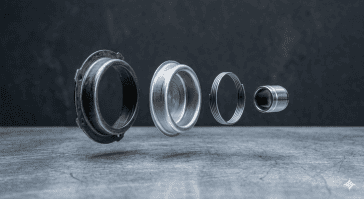
In high-performance mechanical systems, failure rarely begins where it becomes visible. When an oil seal leaks or degrades, the immediate assumption often points to the elastomer or sealing lip. However, those who work closely with sealing assemblies understand a more fundamental truth – reliability is determined much earlier, long before the seal is even installed.
Oil seals are not standalone components. They are part of a carefully engineered system where metal structures, spring elements and bonding interfaces work together to maintain performance under demanding conditions. The real question, therefore, is not how a seal performs in isolation, but how well the components supporting it are engineered.
Understanding Oil Seal Performance as a System
An oil seal functions through a balance of multiple elements; each contributing to its ability to retain lubrication and prevent contamination.
Key contributors include:
- The metal casing: provides structural stability and ensures proper fitment
- The elastomer element: responsible for direct sealing contact
- The garter spring: maintains a consistent radial force
- The interface between materials: where bonding and geometry must remain stable
These elements must operate in harmony. Even slight inconsistencies in one component can disrupt the entire system, especially under high-speed rotation, temperature variation and continuous mechanical stress.
Critical Factors That Influence Reliability
From an engineering standpoint, several factors determine whether an oil seal will perform consistently over time:
Dimensional Accuracy of Metal Components
The geometry of the metal casing defines alignment, press-fit behaviour and overall stability. Any variation can lead to distortion or improper seating.
Consistency in Spring Tension
Garter springs must deliver uniform radial force throughout the lifecycle of the seal. Inconsistent tension can gradually reduce sealing efficiency.
Bonding Compatibility
The effectiveness of rubber-to-metal bonding depends heavily on the quality and stability of the metal surface and structure.
Installation and Fitment Behaviour
Even a well-manufactured seal can fail if the underlying metal components do not maintain proper tolerance during installation.
These factors are interconnected, making reliability a result of precision at every stage of manufacturing.
Where Most Failures Actually Begin
In many cases, oil seal failures can be traced back to upstream inconsistencies rather than visible defects.
Common root causes include:
- Distortion in metal casings due to poor forming control
- Dimensional variation across batches, affecting fitment
- Inadequate structural rigidity, leading to deformation under load
- Inconsistent integration between components, especially at scale
Such issues often remain undetected during initial inspection but become critical under real operating conditions.
Industry Insight: The Shift Toward Component-Level Precision
Across automotive and industrial sectors, OEMs are increasingly focusing on component-level precision rather than relying solely on final assembly checks.
This shift is driven by:
- Stricter performance requirements in modern powertrains
- Greater emphasis on long-term reliability and reduced maintenance
- Export market expectations for consistency and traceability
- A growing preference for specialised suppliers with process discipline
As a result, manufacturers are now evaluating suppliers based on their ability to deliver repeatable, high-precision components that integrate seamlessly into larger systems. This is where the role of an experienced oil seal components supplier in India becomes critical.
Applications That Demand Reliable Oil Seal Performance
Oil seal systems supported by precision metal components are widely used in:
- Automotive engines and transmission assemblies
- Axle and drivetrain systems
- Two-wheeler and three-wheeler platforms
- Industrial rotating equipment
- Agricultural and off-road machinery
Across these applications, the expectation remains consistent – stable sealing performance over extended operating cycles.
Reliability is Engineered, Not Assumed
At Citizen Components, we approach oil seal-related manufacturing with a clear understanding: performance is not defined by a single part, but by how well every component performs within the system.
By focusing on precision sheet metal components, controlled forming processes and integration-ready parts, we support manufacturers seeking consistent sealing performance in demanding environments.
Because in high-performance systems, reliability is never accidental – it is engineered, component by component.
Looking to improve sealing reliability at the component level?
Connect with Citizen Components to explore precision-engineered metal parts designed for consistent oil seal performance.
Our Valued Clients











 Back To Top