

Why Tooling Accuracy Defines the Success of Every Metal Component
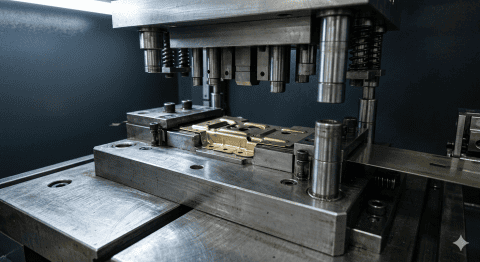
In manufacturing, it’s tempting to evaluate a component only after it comes off the line – measuring dimensions, checking tolerances and validating fitment. But those of us who understand the process more deeply know that the real outcome was decided much earlier.
Before the first part is produced, before machines begin their cycles, precision is already locked in, or compromised, at the tooling stage. Tooling is not just a means to shape metal; it is the foundation that determines whether every subsequent component will meet expectations.
What Tooling Really Controls
At its core, tooling governs how metal behaves during forming. It dictates how material flows, how force is distributed and how consistently a part can be reproduced.
Key aspects influenced by tooling include:
- Dimensional accuracy, ensuring each part meets exact specifications
- Geometric stability, maintaining shape integrity across production runs
- Surface finish quality, which affects downstream processes such as bonding or assembly
- Material flow control, preventing defects like thinning, cracking, or wrinkling
When tooling is engineered correctly, production becomes predictable. When it isn’t, variability becomes inevitable.
The Link Between Tooling and Production Stability
One of the most common challenges in manufacturing is maintaining consistency as volumes increase. A tool that performs well during initial trials may not sustain accuracy across thousands – or millions – of cycles.
Tooling directly impacts:
- Batch-to-batch consistency, especially in high-volume production
- Tool wear behaviour, which influences dimensional drift over time
- Production efficiency, reducing rework and rejection rates
- Long-term reliability, so that components remain within tolerance throughout their lifecycle
This is why tooling must be designed not only for form, but for durability and repeatability.
Tooling in Complex Automotive Applications
In automotive and industrial systems, tooling plays a critical role in producing components that must perform under stress.
Examples include:
- Oil seal metal casings, where roundness and fitment are critical
- Deep-drawn components, requiring controlled material flow
- Load-bearing parts, where structural accuracy cannot vary
- Bonding-ready metal components, where surface quality impacts adhesion
In each case, the final component’s performance is directly linked to the quality and precision of the tool that produced it.
Industry Insight: Why OEMs Prioritise Tooling Capability
Across global supply chains, OEMs are increasingly focusing on suppliers with strong in-house tooling capabilities. The reason is not just efficiency; it is control.
Manufacturers who operate as sheet metal tooling manufacturers bring several advantages:
- Faster response to design changes
- Better alignment between design intent and manufacturability
- Reduced dependency on external tooling vendors
- Greater consistency across production cycles
This shift reflects a broader understanding that precision cannot be outsourced but engineered into the process from the beginning.
Applications That Depend on Tooling Accuracy
Tooling precision supports components used in:
- Automotive engines and drivetrain systems
- Oil seal structural components
- Suspension and load-bearing assemblies
- Two-wheeler and industrial applications
Across these systems, the expectation remains the same, which is repeatable accuracy, stable geometry and dependable performance.
Precision Begins Before Production
At Citizen Components, we view tooling not as a support function, but as a core part of the manufacturing ecosystem. By maintaining control over tooling design and development, we ensure that every component produced reflects the intended geometry and performance requirements.
In precision manufacturing, consistency is not achieved at inspection but built into the process from the start.
Looking for consistent quality at scale?
Connect with Citizen Components to explore how precision tooling supports reliable metal component manufacturing.
Our Valued Clients











 Back To Top